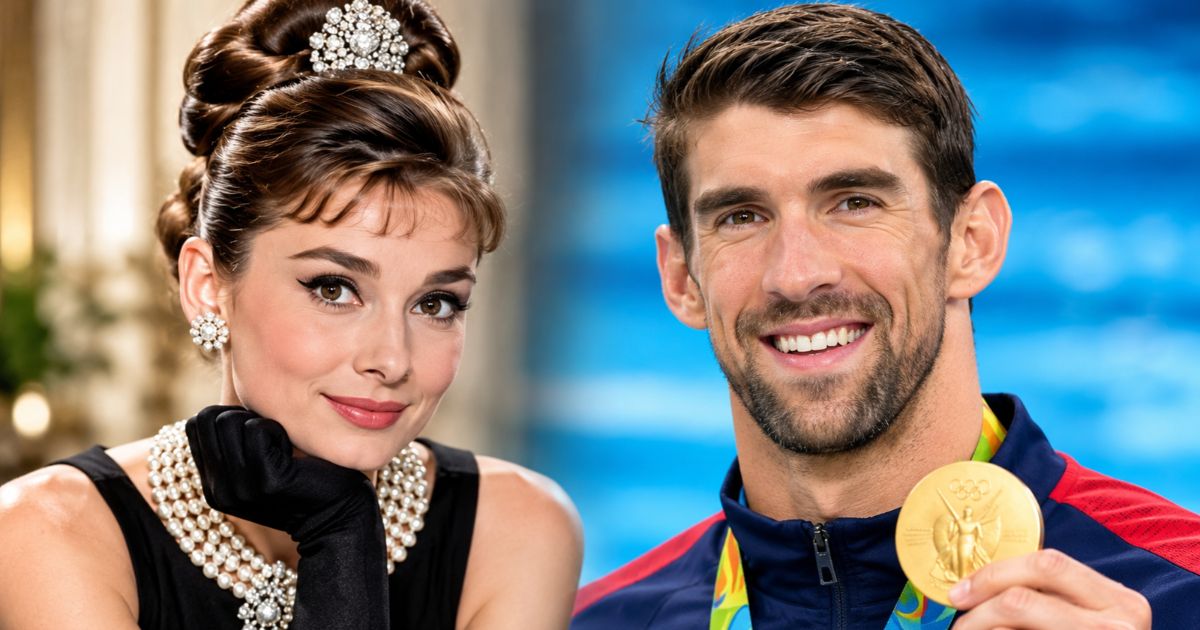
Audrey Hepburn and Michael Phelps: Two American Icons, One Quick Bio Table
Audrey Hepburn and Michael Phelps were never related, never met, and never worked together. Hepburn died on January 20, 1993, when Phelps was seven years old. Still, people search their names side by side every day, usually to compare two record-setting lives from very different worlds.
This guide sticks to verified facts. You will find a side-by-side bio table, a Games-by-Games look at Phelps’s Olympic medals, Hepburn’s humanitarian record, honest context on net worth, and short answers to the questions readers actually ask.
Who Were Audrey Hepburn and Michael Phelps?
Audrey Hepburn was a British actress, fashion icon, and humanitarian. She became a star in Roman Holiday in 1953, won the Academy Award for Best Actress for that role, and spent her final years as a UNICEF Goodwill Ambassador.
Michael Phelps is an American swimmer who retired after the 2016 Rio Olympics. He holds the all-time records for Olympic medals (28) and Olympic gold medals (23), which makes him the most decorated Olympian in history.
One worked on film sets and fashion runways. The other worked in pools and record books. What links them is scale: each became a household name on every continent.
Audrey Hepburn and Michael Phelps Quick Bio Table
| Detail | Audrey Hepburn | Michael Phelps |
| Birth name | Audrey Kathleen Ruston (later Hepburn-Ruston) | Michael Fred Phelps II |
| Born | May 4, 1929 | June 30, 1985 |
| Birthplace | Ixelles, Brussels, Belgium | Baltimore, Maryland, USA |
| Nationality | British | American |
| Occupation | Actress and humanitarian | Competitive swimmer |
| Known for | Roman Holiday, Breakfast at Tiffany’s, My Fair Lady | 28 Olympic medals, 23 gold |
| Top honors | Academy Award, Tony Award, Presidential Medal of Freedom | Most decorated Olympian in history |
| Humanitarian role | UNICEF Goodwill Ambassador (1988 to 1993) | Michael Phelps Foundation, mental health advocacy |
| Spouse | Mel Ferrer, then Andrea Dotti | Nicole Johnson |
| Children | Sean Hepburn Ferrer, Luca Dotti | Four sons |
| Status in 2026 | Died January 20, 1993, aged 63 (would be 97) | Retired, age 41 |
One detail often gets mixed up. Hepburn was born Audrey Ruston. Her father added “Hepburn” to the family surname later, which is why you will see both versions in print.
Audrey Hepburn: Early Life and Background
Hepburn was born in Ixelles, Brussels, to Joseph Ruston, a British businessman, and Ella van Heemstra, a Dutch baroness. Her parents divorced in 1939. Her father wanted a British education for her, so she attended a small private school in Kent, England, from 1937.
Then came the war. Her mother moved her to Arnhem in the Netherlands, hoping neutrality would keep them safe. It did not. Germany occupied the country in 1940, and Hepburn adopted a Dutch-sounding name to hide her English roots.
She trained in ballet through those years. Biographers also report that she helped the Dutch Resistance by carrying messages and performing to raise money. By the Hunger Winter of 1944, food was scarce and she suffered from malnutrition.
That experience shaped everything that followed. After liberation, she received food and medical relief from UNICEF, and she never forgot it. After the war she studied ballet in Amsterdam and later London, where small stage and film roles began to find her.
Related Post: 350+ Cool Game Name Ideas 2026: Unique, Cool & Pro Gamer Names
How Did Audrey Hepburn Become Famous?
Her breakthrough came on Broadway in Gigi in 1951. Two years later, Roman Holiday made her a global star. Playing a runaway princess opposite Gregory Peck, she won the Academy Award for Best Actress in 1953.
The hits kept coming:
- Sabrina (1954): A romantic comedy that deepened her appeal.
- Funny Face (1957): A musical that cemented her fashion image.
- The Nun’s Story (1959): A serious dramatic role that earned praise from critics.
- Breakfast at Tiffany’s (1961): The film behind her most famous costume, the black dress by designer Hubert de Givenchy.
- My Fair Lady (1964): One of the decade’s biggest musicals.
- Wait Until Dark (1967): A thriller that showed her range.
A quick accuracy note: Hepburn received five Oscar nominations in her career but won once, for Roman Holiday. Breakfast at Tiffany’s was a nomination, not a win.
She also won a Tony Award in 1954 for the play Ondine. After her death she received a 1993 Emmy and a 1994 Grammy, so she is counted among the rare performers who have won all four major American entertainment awards.
Her film work slowed sharply after the late 1960s. She returned only occasionally, including a small role in Always in 1989, because family and later humanitarian work came first.
Audrey Hepburn’s Family and Personal Life
Hepburn married actor and director Mel Ferrer in 1954. Their son, Sean Hepburn Ferrer, was born in 1960. The marriage ended in 1968.
In 1969 she married Italian psychiatrist Andrea Dotti. Their son, Luca Dotti, was born in 1970. That marriage ended in 1982.
From 1980 until her death, her partner was Dutch actor Robert Wolders. Friends and biographers describe those final years as the calmest of her life.
She made her home in Tolochenaz, Switzerland, in a house called La Paisible, which she bought in 1963. Many people assume she lived in Hollywood. In reality, she spent most of her adult life in Europe and chose a quiet village over film-industry glamour.
She often said her sons mattered more than her career. After 1993, both sons helped carry her work forward through the Audrey Hepburn Children’s Fund.
What Did Audrey Hepburn Do for UNICEF?
Hepburn became a UNICEF ambassador in 1988, and UNICEF lists her as a Goodwill Ambassador from 1988 to 1993. She considered it the most important role of her life.
Her first field mission was to Ethiopia in 1988. In Mek’ele, she visited an orphanage where about 500 starving children lived and asked UNICEF to send food. She spoke publicly about how deeply the trip affected her.
Over five years she visited more than 20 countries. Key stops included:
- Ethiopia (1988): Famine relief and feeding programs.
- Turkey (1988): A national immunization campaign.
- Latin America: Ecuador, Venezuela, Honduras, and Central America.
- Sudan and Bangladesh: Clean water and basic health programs.
- Vietnam: School and health support for remote communities.
- Somalia (September 1992): Her last mission, only four months before she died.
She also testified before government bodies, gave speeches, and fronted benefit concerts. Her goal was simple: keep children’s needs in the news.
The recognition followed. President George H. W. Bush awarded her the Presidential Medal of Freedom in December 1992. The Academy of Motion Picture Arts and Sciences posthumously gave her the Jean Hersholt Humanitarian Award in 1993. In 2002, UNICEF unveiled a statue called “The Spirit of Audrey” at its New York headquarters.
How Did Audrey Hepburn Die?
Hepburn died on January 20, 1993, at her home in Tolochenaz, Switzerland. She was 63.
The cause was a rare form of abdominal cancer that began in the appendix, known as pseudomyxoma peritonei. She began having stomach pain after returning from Somalia in late 1992. Surgery and treatment followed, but the cancer had spread. She spent her last weeks at home with her family.
Note that some websites repeat claims about her final months that cite no source. This article avoids them. The documented record is clear on the essentials: she kept working for children’s welfare almost to the end, and she died peacefully at home.
Michael Phelps: Early Life and Background
Phelps was born on June 30, 1985, in Baltimore, Maryland, the youngest of three children. His mother, Debbie, was a middle school principal. His father, Fred, was a state trooper. His parents divorced when he was nine, and his mother raised the family.
His older sisters, Whitney and Hilary, swam competitively, and Michael started at age seven. He was also a very energetic kid. He was diagnosed with ADHD in childhood, and his mother saw swimming as a way to channel that energy.
He joined the North Baltimore Aquatic Club and, by age 11, trained under coach Bob Bowman. That partnership lasted through his entire career.
Phelps made his first Olympic team for Sydney 2000 at age 15. He did not medal there, finishing fifth in the 200-meter butterfly. It was a learning experience, not a failure. Four years later, he arrived in Athens ready to dominate.
How Did Michael Phelps Become the Greatest Olympian Ever?
The numbers tell the story. Here is every Games, with the exact medal count:
| Olympic Games | Gold | Silver | Bronze | Total |
| Sydney 2000 | 0 | 0 | 0 | 0 |
| Athens 2004 | 6 | 0 | 2 | 8 |
| Beijing 2008 | 8 | 0 | 0 | 8 |
| London 2012 | 4 | 2 | 0 | 6 |
| Rio 2016 | 5 | 1 | 0 | 6 |
| Career total | 23 | 3 | 2 | 28 |
A few moments stand out.
- Athens 2004: He tied the record of eight medals at a single Games, a mark held by gymnast Alexander Dityatin.
- Beijing 2008: He won eight golds, passing Mark Spitz’s 1972 record of seven at one Olympics.
- London 2012: He added six more medals, then announced his retirement.
- Rio 2016: He came back, carried the U.S. flag at the opening ceremony, and finished with five golds and a silver.
He attended five Olympic Games from 2000 to 2016 but won medals at four of them. He also set 39 world records over his career.
After Beijing, he used a $1 million bonus from Speedo to open the Michael Phelps Foundation, which promotes swimming, water safety, and healthy living for young people.
Michael Phelps’s Family Life
Phelps married Nicole Johnson, a former Miss California USA, in 2016. They have four sons: Boomer, Beckett, Maverick, and Nico. The family lives in Arizona, where Phelps has kept home life mostly private.
His mother, Debbie, remains a visible part of his story. She often appeared at his races and has long been credited with keeping him grounded during years of fame.
Phelps has said that fatherhood changed his priorities. Where swimming once defined everything, family now comes first.
Why Is Michael Phelps a Mental Health Advocate?
Phelps’s public openness about mental health began after he left the pool. He has said that depression hit hard after the 2012 Olympics, and that after a second DUI arrest in 2014, he entered treatment and faced thoughts of suicide. He credits seeking help with changing his path.
Since then, he has become one of sport’s most recognizable voices on the topic. Key steps include:
- Speaking publicly: Interviews and conference appearances where he described his own experience.
- Talkspace partnership (2018): A collaboration with an online therapy company to reduce stigma around seeking help.
- The Weight of Gold: A documentary exploring the mental toll on Olympic athletes.
- Foundation programs: The Michael Phelps Foundation now includes stress management resources for athletes.
His message matters because it comes from someone who looked invincible. Athletes often feel pressure to hide struggles, and his candor made it easier for others to speak up.
If you or someone you know is struggling, support is available. In the United States, you can call or text 988 to reach the Suicide and Crisis Lifeline. Elsewhere, local crisis services can help.
How Much Is Michael Phelps Worth?
Most published estimates put Phelps’s net worth between $80 million and $100 million, with $100 million cited most often. No audited figure is public, so treat these as informed estimates.
His income has come from several streams:
| Income source | Details |
| Olympic prize money | Modest, roughly $640,000 in total reported payouts |
| Endorsements | Speedo, Under Armour, Omega, Visa, Subway, and others |
| Business ventures | Equity in the mental health company Talkspace |
| Media work | Olympic commentary and public appearances |
| Philanthropy | Michael Phelps Foundation (not an income source) |
For comparison, Hepburn’s net worth at the time of her death is often listed at around $55 million, though no verified accounting exists. Her estate also benefits from continued licensing of her image, which makes any single figure uncertain.
Are Audrey Hepburn and Michael Phelps Related or Did They Ever Meet?
No. There is no documented family tie, friendship, or professional contact between them.
The timeline rules out a meeting. Hepburn died in January 1993. Phelps was seven and had not yet joined a national team. His Olympic debut came in 2000, seven years after her death. Searching interviews, biographies, and archives turns up no sign that either ever mentioned the other.
The pairing exists because of search behavior. People type the two names together to compare greatness across fields.
Audrey Hepburn and Michael Phelps: What Do They Actually Have in Common?
On paper, almost nothing. In practice, their paths share a few real patterns.
Shared qualities
- Early discipline: Hepburn trained in ballet as a teenager. Phelps was in the pool by seven.
- Resilience: Hepburn survived wartime hunger. Phelps survived years of depression.
- Record-setting careers: One earned an Oscar, a Tony, an Emmy, and a Grammy. The other earned 28 Olympic medals.
- Purpose beyond fame: Hepburn championed children’s welfare through UNICEF. Phelps champions water safety and mental health.
- Lasting institutions: The Audrey Hepburn Children’s Fund and the Michael Phelps Foundation keep their work alive.
Key differences
- Generation: Hepburn’s peak came in the 1950s and 1960s. Phelps’s came in the 2000s and 2010s.
- Measurement: Phelps’s greatness is counted in medals and times. Hepburn’s is judged in performance, style, and service.
- Nationality: Hepburn was British. Phelps is American.
Audrey Hepburn vs. Michael Phelps: Achievements, Legacy, and Influence Compared
| Category | Audrey Hepburn | Michael Phelps |
| Field | Acting, fashion, humanitarian work | Competitive swimming |
| Peak years | 1950s to 1960s | 2000s to 2010s |
| Signature achievement | Academy Award for Roman Holiday | 28 Olympic medals, 23 gold |
| Honors | Oscar, Tony, Emmy, Grammy, Presidential Medal of Freedom | Most decorated Olympian ever, 39 world records |
| Humanitarian focus | Children’s welfare, famine relief, immunization | Water safety, youth swimming, mental health |
| Cultural footprint | Film and fashion influence, the Givenchy partnership | Olympic sport and athlete wellbeing |
| Institutions | Audrey Hepburn Children’s Fund | Michael Phelps Foundation |
So who had the bigger influence? It depends on what you measure. Phelps owns the numbers. Hepburn owns the image, the style, and a humanitarian legacy that still shapes how people see celebrity advocacy.
FAQs
Are Audrey Hepburn and Michael Phelps related?
No. No documented family connection exists between them.
Did Audrey Hepburn and Michael Phelps ever meet?
No. Hepburn died in 1993, when Phelps was seven years old and years before his Olympic debut.
How many years apart were they born?
56 years. Hepburn was born in 1929 and Phelps in 1985.
Was Audrey Hepburn American?
No. She was a British actress born in Brussels, Belgium, who later lived in Switzerland.
What was Audrey Hepburn most famous for?
She is best known for Roman Holiday, Breakfast at Tiffany’s, and My Fair Lady, plus her UNICEF work.
Did Audrey Hepburn win an Oscar for Breakfast at Tiffany’s?
No. She was nominated for it but won Best Actress for Roman Holiday in 1953.
What did Audrey Hepburn do for UNICEF?
She served as a Goodwill Ambassador from 1988 to 1993, visiting more than 20 countries to advocate for children.
How did Audrey Hepburn die?
She died on January 20, 1993, in Switzerland, at age 63, from a rare cancer that began in the appendix.
How many Olympic medals did Michael Phelps win?
He won 28, including 23 gold, 3 silver, and 2 bronze.
Why is Michael Phelps known for mental health advocacy?
He has spoken openly about depression, anxiety, and ADHD to encourage others to seek help.
How much is Michael Phelps worth?
Estimates range from $80 million to $100 million, and no official figure has been confirmed.
Why are Audrey Hepburn and Michael Phelps mentioned together?
People compare them as two record-setting icons who used fame for causes beyond their careers.
Final Thoughts
Audrey Hepburn and Michael Phelps never crossed paths, and the evidence shows no link beyond a search habit. The comparison works because of what each built: Hepburn turned screen fame into service for children, and Phelps turned Olympic dominance into a conversation about mental health.
If you remember one thing, make it this. Greatness looks different depending on the field, but the pattern repeats: early discipline, hard setbacks, and a decision to use influence for someone else’s benefit.
I’m Rimsha Rabail, a Professional Content Writer with 5 years of experience in creating high-quality digital content. I specialize in Celebrity Biographies, Celebrity Profiles, Entertainment Writing, and SEO-Optimized Articles. My focus is on delivering well-researched, original, and engaging content that builds reader trust and provides valuable insights.